


Ball Sort Game - Color Puzzle
4.92.57K Reviews
App Specs
- Version
- 5.3
- Updated On
- License
- Free
- Downloads
- 1,000,000+
- Developer
- Words Mobile
- Categories
- Puzzle
- Platform
- Android
Screenshots
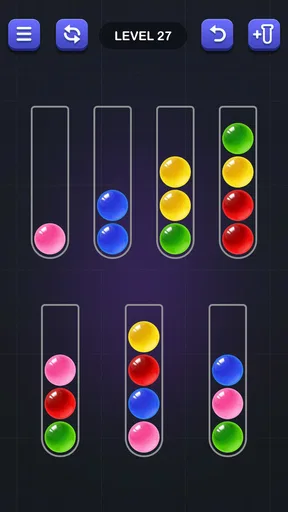
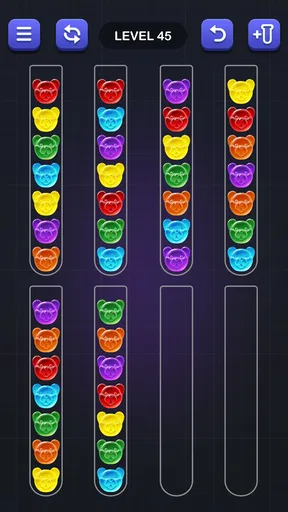
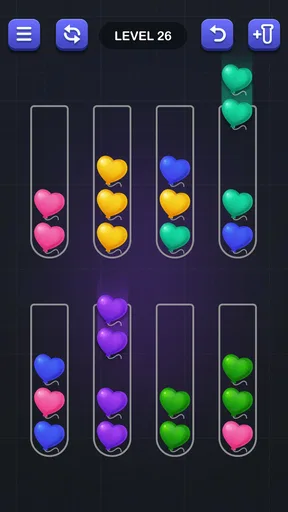
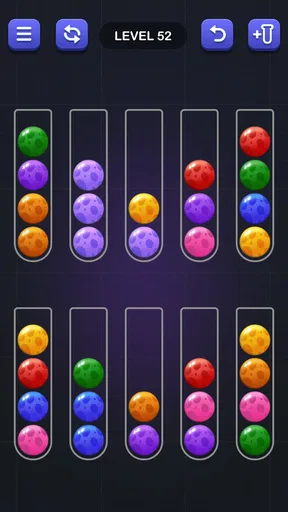
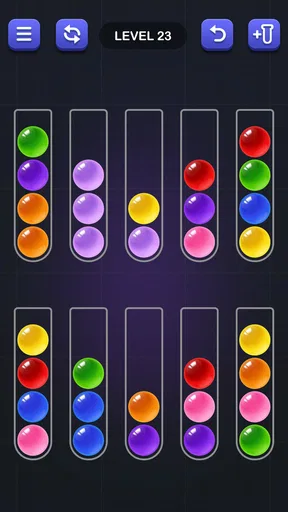
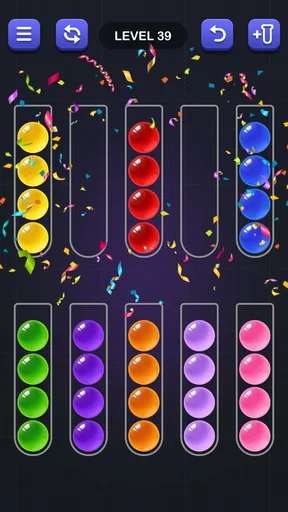
 Analysis by AppCompare
I tried Ball Sort Game - Color Puzzle as the kind of puzzle I could pick up for a few minutes without preparing for a long session. Its idea is immediately clear: colored balls sit in tubes, and I have to rearrange them until each tube contains one color. That simplicity is the main attraction, but it also makes the quality of the experience depend on small details such as how readable the board feels, how forgiving a mistake is, and whether the difficulty remains interesting after the first few rounds.
This is a free puzzle game from Words Mobile, aimed at Everyone and compatible with Android devices running version 5.0 or later. It has reached over a million installs, with an average score of 4.9 from roughly seventy-three thousand ratings. Those figures suggest that the straightforward format works for a large audience, but they do not answer the more useful question: is it the right sort of puzzle for you? My answer depends less on how much you enjoy games in general and more on whether you want calm, repeatable sorting rather than story, speed, or constant novelty.
How to decide whether this sorting puzzle suits you
I use this section to make the choice practical: the key question is whether arranging colors feels satisfying enough to bring you back after the first few easy boards. Try noticing whether you naturally pause to protect spare space or whether you find yourself tapping just to finish. That small distinction helps separate a soothing routine from a puzzle loop that may soon feel repetitive.
The real appeal is low-pressure concentration
When I choose a casual puzzle, I usually look at three things first. Can I understand it without a tutorial? Can I stop in the middle without feeling that I have wasted a competitive attempt? And does it make me think without turning a short break into a stressful task? This game performs well on those criteria because the central action is visual and familiar almost immediately. I do not need to learn a character system, remember a storyline, or understand a complicated menu before making the first move.
The board asks me to place balls into tubes while respecting the available room and the colors already present. A move that looks harmless can close off a useful tube, so the game is not completely automatic. I have to look ahead, preserve temporary space, and decide which color should be exposed first. That creates a gentle form of planning: the challenge comes from arranging the order of actions rather than from fast reactions.
For me, the best use is a short mental reset. I can play while waiting for an appointment, during a quiet commute, or at the end of the day when I want something more active than scrolling but less demanding than a full strategy game. The lack of a complicated premise is helpful in those moments. I can return after a pause and understand the position without reconstructing a plot or remembering a collection of objectives.
What I pay attention to before committing
A sorting game can become repetitive if every level feels like the same arrangement with only minor changes. I therefore judge it by the quality of its decisions, not just by the attractive simplicity of its rules. A good board should make me consider several possible openings and recognize that a tube with spare capacity is a resource, not merely an empty container.
Worth Reading Before You Choose

EA SPORTS FC Mobile 26 Is a Bigger Football Game, but It Takes Time

Flipboard Shows What News Apps Must Do Beyond the Feed

Switching to Android Auto Means Rethinking Your Driving Routine

Google Calendar Makes a Crowded Week Easier to Manage

Ludo King Makes the Most of the Minutes Between Plans

Baby Panda World Brings Quick Play to Modern Phones, but Its Game Library Feels Busy
One practical test is to avoid moving the first available ball automatically. I look for a color that is blocking another color, then ask whether moving it will create useful space or merely shift the problem elsewhere. This habit makes the early boards more engaging and remains useful when the layout becomes less obvious. It also shows the difference between playing thoughtfully and tapping until a solution happens by accident.
Another decision criterion is tolerance for repetition. This is not a narrative puzzle with new characters or a changing world to explore. Its satisfaction comes from cleaning up a mixed arrangement. If that process itself feels rewarding, the game can be remarkably easy to revisit. If you need fresh mechanics, dialogue, timed events, or a strong sense of progression, the same simplicity may feel thin.
Why the format works for everyday breaks
Imagine having ten minutes before leaving home. You do not want to start a game that demands a long uninterrupted run, but you also do not want a completely passive distraction. I would use this title in that situation because one board gives my attention a clear target. I can begin with a quick scan, make a few deliberate moves, and stop when the arrangement is solved or when I need to go.
The same quality makes it suitable for players who prefer quiet concentration. There is no need to coordinate with another person, maintain a team schedule, or react to an opponent. A parent waiting outside an activity, a student taking a short break, or someone winding down before sleep can approach it at their own pace. It is also a reasonable choice for people who find conventional brain-training apps too formal or too full of separate exercises.
That said, I would not describe every session as equally relaxing. When I make an early mistake, the board can become more complicated than it first appeared. The calm presentation does not remove the need to undo a poor plan mentally. Its relaxed character comes from the absence of time pressure, not from every position being effortless.
Where it wins against familiar puzzle alternatives
Compared with a crossword, this game asks for less language knowledge and gives more immediate visual feedback. I do not need a large vocabulary or a particular cultural background to understand the objective. Compared with a match-three puzzle, it is less about quick pattern recognition and more about preserving space for later moves. Compared with a sudoku-style grid, it feels more tactile because each action changes the visible arrangement of objects.
It also has an advantage over puzzle games built around a large map or a long campaign: I can focus on the current arrangement instead of managing a broader progression system. That makes it easier to recommend to someone who wants a single repeatable activity rather than a hobby that gradually takes over their free time.
The trade-off is equally clear. Word puzzles offer richer variety through clues and meanings. Match-three games often provide more visual energy and changing objectives. Sudoku offers a stronger feeling of deduction for players who enjoy fixed logical constraints. Ball sorting sits between those experiences: it is more deliberate than a reflex puzzle and more immediately accessible than a dense logic grid.
Small techniques that improve the experience
The first useful technique is to treat an empty tube as a temporary workbench. I try not to fill it just because it is available. Keeping that space open can let me separate a buried ball, expose a matching color, or reverse an earlier arrangement. Using every free slot immediately is one of the easiest ways to remove my own options.
The second is to plan in color groups rather than individual balls. If I can see that two matching balls are separated by a different color, I consider which move will uncover the pair without trapping the intervening piece. This reduces random tapping and makes a solution feel more like a sequence I discovered than a lucky chain of moves.
The third is to pause after a mistake instead of continuing automatically. Once I have filled a tube in an unhelpful way, several later moves may simply hide the original error. I find it more efficient to review the last few decisions and rebuild the position mentally. That approach is especially useful for players who want the game to exercise planning rather than patience alone.
A fourth tip is to use the early part of a board as information gathering. I do not need to solve immediately. I can move one exposed ball, observe which colors become available, and use that result to choose the next temporary destination. This is a safer method than committing to a long sequence based only on the first visual impression.
Where the game may not be the best choice
I would skip this title if my main goal were social play. The core appeal is solitary sorting, so it does not replace a word game I can play with friends or a competitive puzzle where another person changes the pressure. I would also choose something else if I wanted a story-driven experience, character development, or a sense of exploration beyond the current board.
Players who dislike repeating one central mechanic may reach that conclusion quickly. Even when the arrangement changes, the basic action remains the same: move colored balls while protecting usable space. That consistency is comforting for some people and limiting for others. The game is strongest when I want refinement of one idea, not a collection of unrelated mini-games.
It may also be a poor fit for anyone seeking a guaranteed no-friction experience. A calm puzzle can still produce frustration when a move closes the only practical route to a color. If I want something that I can play almost mindlessly, a simple arcade title may suit me better. If I want deep deduction with carefully defined clues, a traditional logic puzzle may offer more intellectual variety.
What switching from another puzzle app feels like
The cost of switching is low if I am coming from another casual sorting or matching game. I do not have to change my whole routine: open the game, inspect the board, solve a compact challenge, and put it away. The main adjustment is mental. Instead of searching for an immediate match, I need to think about the order in which space becomes available.
The switch is less attractive if I am invested in a long campaign elsewhere. A narrative game gives me reasons to return that are separate from the puzzle itself, while this title depends almost entirely on whether I still enjoy arranging colors. Moving over means giving up that broader context in exchange for a cleaner, more focused activity.
Because the game is free, trying it does not require a purchase decision. That makes it easy to test during a normal break rather than deciding in advance that it will become a permanent favorite. I would give it several short sessions, paying attention to whether I start planning more carefully or simply repeat the same moves without interest. That is a better indicator of fit than the first few easy boards.
Version, accessibility, and practical expectations
The current release is version 5.3, and the Android requirement of 5.0 or later makes it approachable for many older devices as well as newer ones. The Everyone content rating also matches the uncomplicated nature of the puzzle. I would still judge the experience on the particular phone or tablet being used, especially if small colored pieces are difficult to distinguish or if touch controls feel cramped on a compact screen.
Color recognition matters more here than in many word-based puzzles. If two shades look too similar on a particular display, sorting becomes needlessly tiring. I recommend checking the board in the lighting where I normally play and increasing attention to the shape and position of groups rather than relying only on quick color impressions. This is not a replacement for accessibility tools, but it is a useful habit when visual conditions are less than ideal.
Another practical expectation is that free mobile games can feel different from paid, tightly curated puzzle collections. I approach this one as a convenient casual download, not as a substitute for a premium logic title with a carefully structured campaign. That distinction helps set the right standard: the value is in having an approachable sorting activity ready when I want it, rather than in delivering an expansive puzzle universe.
My recommendation for different kinds of players
I recommend Ball Sort Game - Color Puzzle to anyone who enjoys visual organization, short solo sessions, and puzzles that reward thinking ahead without demanding fast fingers. It is especially suitable for a person who wants a simple routine for waiting rooms, quiet evenings, or brief breaks. The free price removes much of the risk of trying it, and the rules are clear enough that I can start playing without studying instructions.
I recommend it less strongly to players who need constant novelty, competitive tension, multiplayer interaction, or a story to carry them from one session to the next. For those needs, a word puzzle, sudoku app, match-three game, or narrative adventure may be a better choice depending on whether language, deduction, speed, or exploration matters most.
My final judgment is that the game succeeds by staying focused. It does not need a complicated premise to make a few minutes feel purposeful. The strongest moments come when I protect an empty tube, uncover a blocked color, and solve the board through a sequence that was visible only after careful planning. The weakest moments come from the same narrow design: once sorting stops feeling satisfying, there is little else to pull me back.
If that central loop sounds appealing, I think it is worth installing and testing during ordinary short breaks. I would begin slowly, keep one tube available as working space, and resist moving pieces simply because they can be moved. Used that way, this free puzzle from Words Mobile offers a calm but genuine exercise in order and foresight, with enough decision-making to feel rewarding while remaining easy to pick up.
Pros
- Simple rules make it easy for anyone to start playing.
- Smooth tap-and-pour controls feel responsive on mobile devices.
- Short levels are convenient for quick breaks or casual play.
- Colorful visuals make the tubes easy to distinguish.
- Gradually harder puzzles provide a satisfying sense of progress.
Cons
- Later levels can feel repetitive due to the same core mechanic.
- Some puzzles may require restarting after a single poor move.
- Ads can interrupt the experience
- depending on the game version.
- Limited gameplay variety may not appeal to players seeking action.
- Color-based sorting can be difficult for users with color-vision issues.
FAQs for Ball Sort Game - Color Puzzle
What is Ball Sort Game - Color Puzzle?
Ball Sort Game - Color Puzzle is a casual logic game in which you organize colored balls inside tubes until every tube contains balls of only one color. The rules are simple to understand, but later levels require careful planning, because a single unnecessary move can limit your available space. It is designed for short, relaxing play sessions and does not require previous puzzle-game experience.
How do you play Ball Sort Game - Color Puzzle?
To play, tap a tube to pick up the top ball and then tap another tube to move it. A ball can usually be placed only on a ball of the same color or into an empty tube, and tubes have limited capacity. The objective is to separate all colors correctly using as few moves as possible. Watching the available spaces before moving is especially important on difficult stages.
Is Ball Sort Game - Color Puzzle suitable for beginners?
Yes, the game is generally suitable for beginners because its controls are straightforward and the early puzzles work as a practical tutorial. You can learn the movement rules within a few turns, while the increasing difficulty gradually introduces more colors and tighter arrangements. Players who enjoy sorting, matching, and light brain-training challenges should find the learning curve accessible without feeling overwhelming at the start.
Does Ball Sort Game - Color Puzzle work offline?
Many sorting puzzles can be played without a continuous internet connection, which makes this type of game convenient for travel, waiting rooms, or quick breaks. However, features such as advertisements, cloud synchronization, daily challenges, analytics, or optional rewards may require an internet connection depending on the version installed. It is best to check the app-store description and test offline access after installation.
Are there advertisements or in-app purchases in Ball Sort Game - Color Puzzle?
The game may include advertisements, particularly between levels or when you request a hint, because free puzzle titles commonly use ads as their main source of revenue. Some versions can also offer optional purchases to remove advertising, obtain hints, or unlock additional benefits. Before downloading, review the current Google Play or App Store listing for the exact pricing, permissions, and purchase options available in your region.


